There’s a version of e-commerce SEO that most brands are familiar with. Write category page copy. Build some backlinks. Publish a blog. Rinse, repeat, report on traffic.
And then there’s the version that actually moves the needle – and it almost always starts with a question nobody’s asking often enough: what’s happening on the product page itself?
Product pages are the closest thing e-commerce has to a salesperson. They’re where intent meets decision. Where a shopper who found you goes from “maybe” to “yes” – or quietly navigates away to a competitor. And yet, in most SEO strategies, product pages get a fraction of the attention that category pages or blog content receive.
That’s a mistake worth correcting.
Why Product Pages Get Ignored
Part of the reason is structural. Most e-commerce platforms – Shopify, WooCommerce, Magento, take your pick – generate product pages automatically, often with thin or templated content, duplicated descriptions pulled from manufacturers, and almost no thought given to how Google evaluates them relative to search intent.
When you have ten product pages, you can probably manage them manually. When you have a thousand, the idea of optimising each one individually feels overwhelming. So most brands don’t do it at all, or they do it in a surface-level way – add a keyword here, tweak a title tag there – without addressing the underlying structural and content issues that hold rankings back.
There’s also the question of where SEO effort tends to get prioritised. Category pages and blog content are naturally where strategists spend most of their energy, because those pages tend to have higher search volume and more obvious content opportunities. Product pages, by contrast, feel harder to work with – they’re more constrained, more templated, more dependent on design and platform limitations.
But here’s the thing: a product page that ranks well and converts well is worth more than almost anything else in your organic search programme. The traffic is highly qualified. The intent is explicit. The value per visit is high. Getting this right, even for a subset of your catalogue, can have a disproportionate impact on revenue.
The SEO Mechanics That Actually Matter
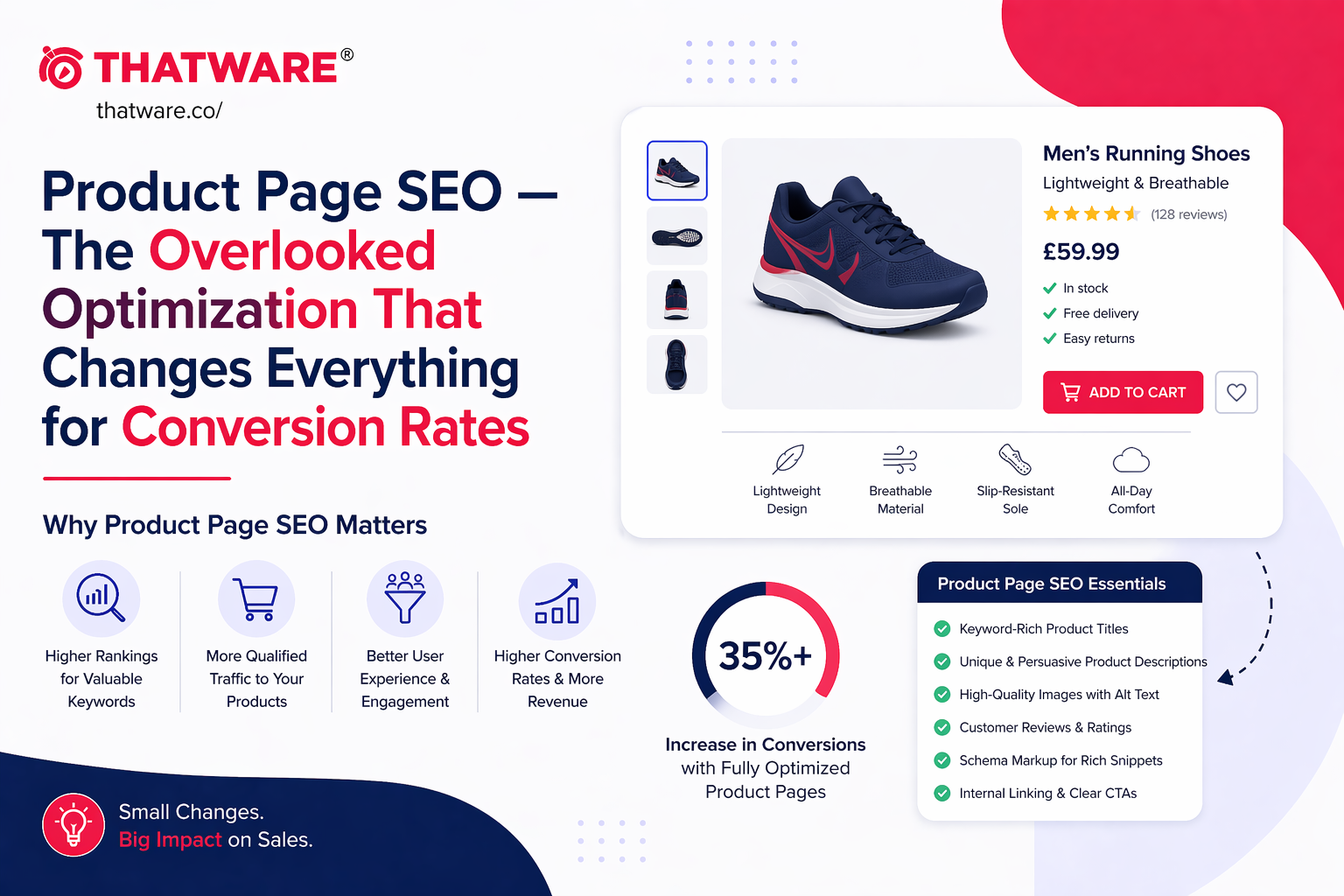
When it comes to product page seo, there are a few fundamentals that surprisingly few brands have actually implemented correctly.
Title tags and meta descriptions. These still matter more than a lot of people acknowledge. A product page title tag should lead with the most specific, commercially relevant keyword variant – not the generic product category, not the brand name first, not a creative headline that no one’s searching for. It should reflect exactly how a buyer with purchase intent would phrase that query.
Structured data. Product schema markup – price, availability, review ratings, SKU – tells Google what your page is about at a machine-readable level and unlocks rich result features in the SERPs. Most e-commerce platforms have plugins or native support for this, but implementation errors are extremely common and often go unnoticed for months.
Page content depth. The product description that the manufacturer gave you is likely sitting on dozens of other websites. Google knows this. Thin, duplicated content doesn’t rank – and in competitive categories, it actively disadvantages you. Product pages that perform tend to have genuinely useful, original descriptions that go beyond basic specs. Sizing information, material details, use cases, who it’s for and who it isn’t for.
Image optimization. Alt text, file names, image compression – this sounds like basic stuff, but it’s routinely done poorly across large catalogues. And with Google Lens and visual search growing, image optimisation is becoming a more significant ranking factor than it used to be.
Internal linking. How do shoppers discover your product pages from elsewhere on your site? If the answer is “only through navigation menus,” you’re leaving significant ranking authority on the table. Category pages, blog content, and comparison pages should all be linking to relevant products in contextually useful ways.
Where Conversion Rate Fits In
Here’s the part that pure SEO strategies often miss: your product page’s conversion rate is a ranking signal.
Not directly, in the sense that Google can read your Shopify analytics – it can’t. But indirectly, through engagement signals. Time on page, bounce rate, the likelihood that a visitor who came through organic search had a satisfying experience – these all feed into how Google evaluates a page’s quality over time.
A product page that ranks on page one but has a 95% bounce rate because it loads slowly, looks untrustworthy, or doesn’t actually answer what the searcher was looking for – that page is not going to hold its rankings. Google has gotten remarkably good at inferring quality from behavioural signals, and a page that consistently fails visitors will eventually lose ground to pages that don’t.
This is why the best ecommerce seo services treat product page work as a joint SEO-and-CRO problem. The question isn’t just “does this page rank?” It’s “does this page rank and convert?” Getting one without the other is only half the job.
Practical elements that matter for both: page load speed (particularly on mobile), trust signals like reviews and social proof, clear and prominent calls to action, photography quality, and the overall sense that this is a legitimate, well-run business. These aren’t soft, fuzzy concerns – they have measurable impact on both conversion rate and organic performance.
Scaling the Problem
The challenge with product page optimization at scale is real. If you have a large catalogue, you cannot manually rewrite every product description. But there are intelligent approaches that don’t require treating every product page as a blank canvas.
Segmenting your catalogue by commercial value is a good start. Which product categories drive the most revenue? Which ones have the most competitive search landscape? Which ones are you currently ranking on page two or three for, where a focused push could move you into meaningful organic visibility? Start there, and work outward.
Templated improvement – creating a better structural framework for all product pages, even before individual content is updated – can also move the needle across the board. A better title tag structure, consistent schema implementation, and improved internal linking can all be applied programmatically at scale.
For your highest-priority products, genuine individual attention is worth it. A well-written, thoroughly optimised product page for a high-margin, high-search-volume product can generate significant, sustained organic revenue over months and years. That ROI often dwarfs what most brands spend on content marketing.
The Bottom Line
Product pages are where organic search traffic converts into revenue. Getting them right – both technically and from a content perspective – is one of the highest-leverage activities in e-commerce SEO.
Most brands are leaving significant organic visibility and conversion rate on the table because they haven’t approached product page optimisation with the rigour it deserves. The ones that do – the ones that treat product pages as a proper SEO and conversion asset rather than an afterthought – tend to see results that surprise them.
If your organic traffic is decent but your product pages aren’t converting the way they should, the answer probably isn’t more content. It’s a closer look at what’s actually happening on those pages – and a willingness to fix it properly.